

Emotions can be powerful, confusing, and sometimes difficult to put into words. Many people know they feel “bad” or “off” but struggle to explain exactly what they’re feeling. The Emotion Wheel, developed by psychologist Robert Plutchik, was designed to solve this problem by offering a clear, visual way to identify, organize, and understand emotions. By helping people label what they feel more precisely, the Emotion Wheel supports emotional awareness, communication, and emotional regulation.
What Is the Emotion Wheel?
The Emotion Wheel is a model that visually represents emotions using color, intensity, and structure. Its purpose is to simplify complex emotional experiences and make them easier to recognize and describe. At its core, the wheel reflects the idea that emotions vary in strength, can blend together, and often share similarities with nearby emotions.
What is an Emotion?
Before understanding the wheel itself, it helps to define what an emotion is. Emotions are short-lived responses to real or perceived events in our environment. They prepare us to act. For example, fear might signal us to retreat from danger. Unlike moods, which can linger for days, emotions tend to last seconds or minutes and involve coordinated responses across the body, behavior, and subjective experience.
Theories Behind Emotions
There are two major perspectives that help explain how emotions work. The evolutionary theory suggests emotions developed to support survival. From this view, emotions are biologically hardwired, universal, and linked to specific brain processes. Fear, for example, promotes withdrawal and self-protection. Plutchik’s Emotion Wheel is grounded in this evolutionary framework.
In contrast, the social constructivist theory argues that emotions are shaped by culture, language, and past experiences. According to this perspective, people interpret bodily sensations differently depending on their upbringing and social context. Some emotions may not even exist in certain cultures due to language differences. While these theories differ, both agree that emotions are powerful and that labeling them is deeply valuable.
The Structure of Plutchik’s Emotion Wheel
Plutchik identified eight core emotions that form the foundation of the wheel: grief, loathing, terror, vigilance, rage, admiration, amusement, and ecstasy. These primary emotions appear at their most intense near the center of the wheel. As you move outward, the emotions become less intense.
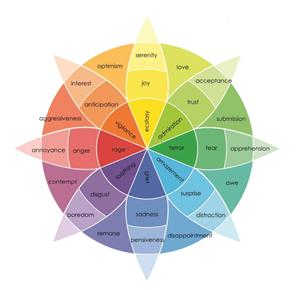
The wheel also shows how emotions relate to one another. Emotions positioned close together are more similar, while those across from each other represent opposites. Additionally, emotions can blend, creating more complex feelings. For instance, combinations of different emotions can produce experiences such as disapproval or mixed emotional states.
The Three Components of Emotion
The Emotion Wheel reflects the idea that emotions consist of three interconnected parts. First, emotions are tied to physiological responses, such as changes in heart rate or sweating. Second, emotions involve expressive behaviors, including facial expressions, tone of voice, or actions. Third, emotions include a subjective feeling component, which is how we consciously experience and describe our emotions.
Why Emotions Matter
Plutchik believed every emotion serves a purpose. Each one motivates behaviors that once helped humans survive, however, they still influence us today. For example, fear can prompt withdrawal to protect against emotional or psychological harm, just as it once protected us against physical danger.
How to Use the Emotion Wheel
The Emotion Wheel can be used in therapy, group discussions, or personal reflection. It helps people identify suppressed feelings, recognize emotional patterns, and understand how different emotions interact. It can also support emotional regulation by helping individuals move from distressing emotions toward more manageable or positive states.
Why the Emotion Wheel Works
Using precise language to describe emotions improves emotional awareness and communication. Research shows that people who can label emotions in more detail tend to be more resilient and psychologically healthy. By combining color, structure, and symbolism, the Emotion Wheel makes emotional exploration more accessible. It offers a practical and insightful way to better understand what we feel and why it matters.
To explore more about your emotions or to speak with a professional counselor about any mental health challenges or concerns, please call Olive Branch Counseling Associates at 708-633-8000. You can meet with a professional counselor in person at 6819 167th St. in Tinley Park, IL 60477, or we can arrange a telehealth appointment. It is our pleasure to be of service to you.
Molly Vacha
Graduate Intern, 2026
Olive Branch Counseling Associates, Inc.
Reference Karnilowicz, H. R. (n.d.). The Emotion Wheel: Purpose, Definition, and Uses. The Berkeley Well-Being Institute. https://www.berkeleywellbeing.com/emotion-wheel.
 CounselingMatters.live
Leave a comment